



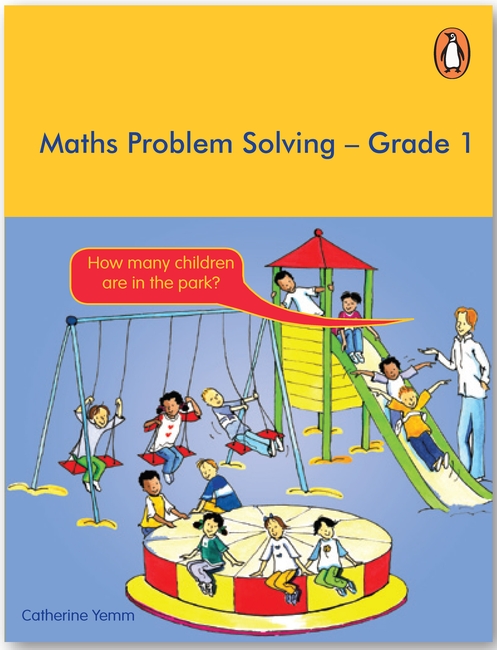
The book cover the ‘solving problem’ objectives from the numeracy framework. They are designed in such a way that each section has six stages of questions to be worked through. Every stage is split into three levels, for example 1a, 1b or 1c, based on achievement. Each corresponding question from these levels follow the same line of questioning, so that when the teacher talks about a certain question, the solution process is the same for each level but the complexity of the sum varies.
Archives: Books
Mighty Fun Activities for Practising Times Tables, Book 3
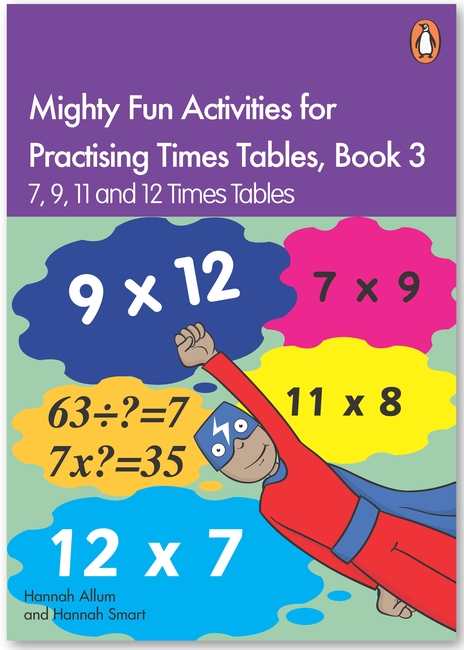
The Mighty Fun Activities for Practising Times Tables series uses superheroes to motivate children to practise all of the skills needed to solve multiplication, division and word based times table problems. Superheroes appeal to even the most reluctant of learners and instil a positive and competitive attitude towards learning. The aim is for children to become excited and motivated enough to want to learn and practise their times tables.
The mighty superheroes are based upon the sporty characters in our highly popular whole-school reward-based scheme, The Mighty Multiples Times Table Challenge.
The sheets in this book can be used in conjunction with the series or independently. There are three books in the Mighty Fun Activities for Practising Times Tables series: Book 1: 2, 5 and 10 times tables
Book 2: 3, 4, 6 and 8 times tables
Book 3: 7, 9, 11 and 12 times tables
The books contain reproducible sheets and are designed to be used as flexible teaching aids which teachers can dip in and out of in any order to support the learning of any times table. They work equally well as stand alone 5 to 20 minute lesson reinforcements or as regular times table learning.
We recognise that all children learn in different ways and that they need to have opportunities to apply their knowledge and skills. For each times table there is a mixture of practical activities to develop their understanding and written activities to consolidate their knowledge. There is also an exciting wrist watch and mask for each times table for children to make and wear. These can be used as an introduction to each character or to consolidate learning. Children will become mightily good at their times tables by using their mighty powers! Looking at their watch or mask is a fun and exciting way to memorise the times tables.
The mixed times table sheets at the back of the book allow children to apply the skills gained in learning individual tables, working out for themselves which multiple facts and methods they need to use.
Mighty Fun Activities for Practising Times Tables, Book 2
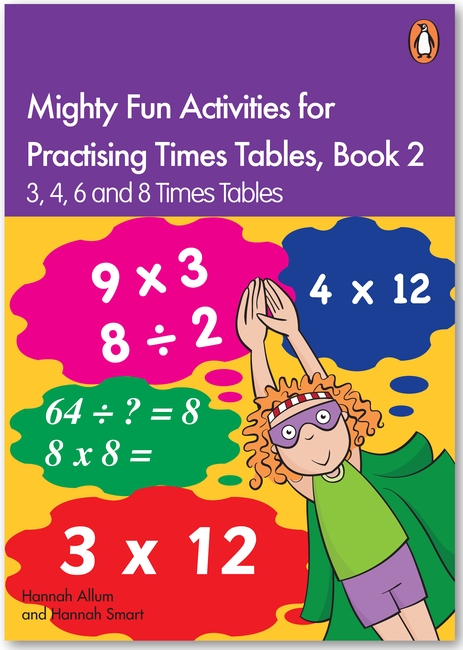
The Mighty Fun Activities for Practising Times Tables series uses superheroes to motivate children to practise all of the skills needed to solve multiplication, division and word based times table problems. Superheroes appeal to even the most reluctant of learners and instil a positive and competitive attitude towards learning. The aim is for children to become excited and motivated enough to want to learn and practise their times tables.
The mighty superheroes are based upon the sporty characters in our highly popular whole-school reward-based scheme, The Mighty Multiples Times Table Challenge.
The sheets in this book can be used in conjunction with the series or independently. There are three books in the Mighty Fun Activities for Practising Times Tables series: Book 1: 2, 5 and 10 times tables
Book 2: 3, 4, 6 and 8 times tables
Book 3: 7, 9, 11 and 12 times tables
The books contain reproducible sheets and are designed to be used as flexible teaching aids which teachers can dip in and out of in any order to support the learning of any times table. They work equally well as stand alone 5 to 20 minute lesson reinforcements or as regular times table learning.
We recognise that all children learn in different ways and that they need to have opportunities to apply their knowledge and skills. For each times table there is a mixture of practical activities to develop their understanding and written activities to consolidate their knowledge. There is also an exciting wrist watch and mask for each times table for children to make and wear. These can be used as an introduction to each character or to consolidate learning. Children will become mightily good at their times tables by using their mighty powers! Looking at their watch or mask is a fun and exciting way to memorise the times tables.
The mixed times table sheets at the back of the book allow children to apply the skills gained in learning individual tables, working out for themselves which multiple facts and methods they need to use.
Mighty Fun Activities for Practising Times Tables, Book 1
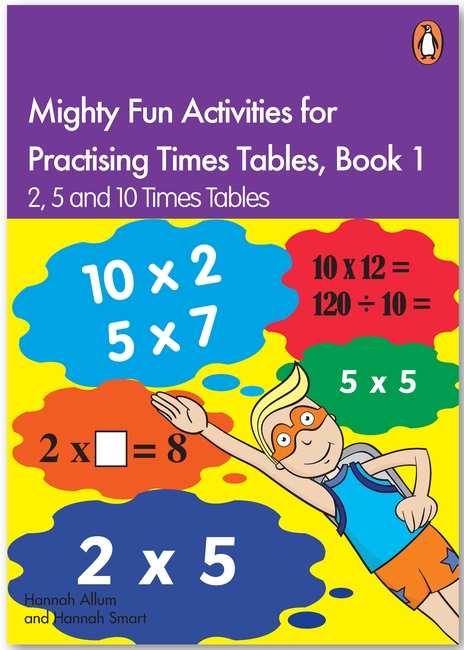
The Mighty Fun Activities for Practising Times Tables series uses superheroes to motivate children to practise all of the skills needed to solve multiplication, division and word based times table problems. Superheroes appeal to even the most reluctant of learners and instil a positive and competitive attitude towards learning. The aim is for children to become excited and motivated enough to want to learn and practise their times tables.
The mighty superheroes are based upon the sporty characters in our highly popular whole-school reward-based scheme, The Mighty Multiples Times Table Challenge.
The sheets in this book can be used in conjunction with the series or independently. There are three books in the Mighty Fun Activities for Practising Times Tables series: Book 1: 2, 5 and 10 times tables
Book 2: 3, 4, 6 and 8 times tables
Book 3: 7, 9, 11 and 12 times tables
The books contain reproducible sheets and are designed to be used as flexible teaching aids which teachers can dip in and out of in any order to support the learning of any times table. They work equally well as stand alone 5 to 20 minute lesson reinforcements or as regular times table learning.
We recognise that all children learn in different ways and that they need to have opportunities to apply their knowledge and skills. For each times table there is a mixture of practical activities to develop their understanding and written activities to consolidate their knowledge. There is also an exciting wrist watch and mask for each times table for children to make and wear. These can be used as an introduction to each character or to consolidate learning. Children will become mightily good at their times tables by using their mighty powers! Looking at their watch or mask is a fun and exciting way to memorise the times tables.
The mixed times table sheets at the back of the book allow children to apply the skills gained in learning individual tables, working out for themselves which multiple facts and methods they need to use.
Revenge of Gaia
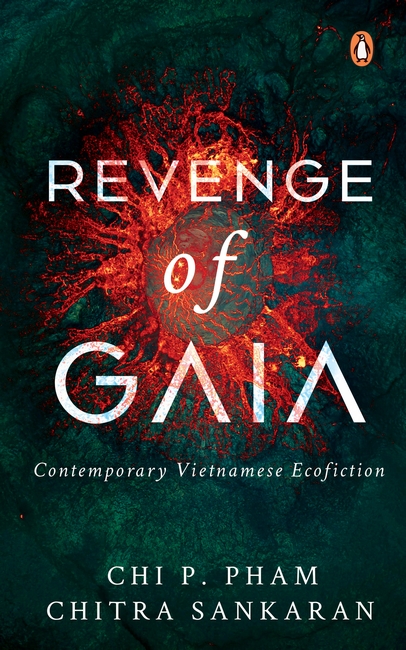
Vietnamese literature, officially an ideological state instrument of nation-building, eulogizes acts that celebrate the victory and the power of human beings over the natural world. Generations of Vietnamese have been taught in school that Vietnam has ‘forests of gold’ and ‘seas of silver’ as well as fertile land. Vietnamese literary works, whether about the non-human or the human world, potentially reflect and resonate to these political orientations in environmental policies that ultimately serve the path to ‘progress’, ‘development’ and ‘modernisation’ of the nation.
The fiction chosen for this collection have been in active circulation in Vietnam since 1986, ‘The Reform Year’, when Vietnamese artists and writers were politically and culturally ‘liberated’ and engaged with great commitment in criticizing, among other things, the government’s environmental policies and ways in which these were enmeshed in economic strategies and schemes for so-called national progress. Thus, modernization and industrialization that were the chosen paths of the postcolonial Vietnamese government, become the major targets of contemporary Vietnamese ecofiction.
All these stories, extremely contemporary, emphasise a counter-narrative that challenges socialist goals of development and modernisation. They articulate and affirm a more holistic vision, where man is no longer a predator but a participant of nature. These stories therefore are politically charged and pave the path for a more visionary future.
The Twelve Habits of Smart Skill-Building
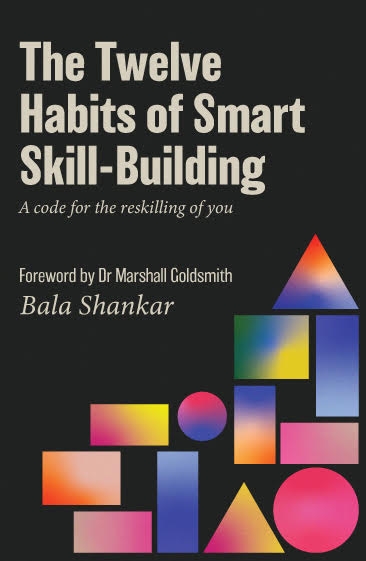
Human improvements have always been the backbone of inventions that advanced mankind. These were based on both knowledge and skills that we gained from time to time. Never before in the past decades has the topic of skills received as widespread attention and debate as now, with dominant opinion equating success with upskilling or reskilling – and failure with stagnant skillsets.
The concept of lifelong learning is challenging the old school maxim of frontloading all education. It is therefore intriguing to understand how people can take their core skills to new areas of work. What is the morphing mantra? How do people reshape their skillsets even when they are out of school? As knowledge and skill become increasingly crucial in the human versus machine competition, should we be analysing how we use old skills to do new tasks? And develop new skills with old abilities? What habit patterns helped successful people embrace skill-learning and build it as a second nature?
The Monk Prince
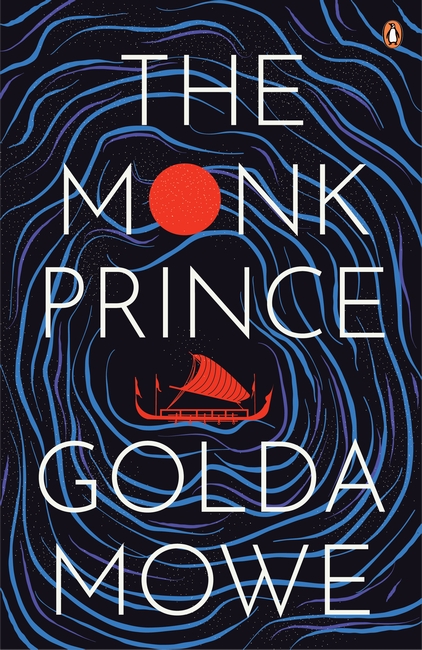
After twenty years of searching, King Waluyo finally gets his son back. He cannot understand why his beloved younger wife had insisted that their son become a monk. What was she hiding from him? Why did she want to separate their only child from him? When he learns that Alak Tegoh the crown prince is not his biological son, he realises that Queen Megabintang may have poisoned his other children. To protect his only living child and the people of his kingdom, Waluyo must use all his political acumen. His biggest hurdle, however, is Parantapa’s attitude towards politics and war. Can he persuade his son to relinquish his Buddhistic upbringing of non-violence? Or will he fail and see all that he has built fall into the hands of his brother-in-law, King Jayagapor?
The Ash House
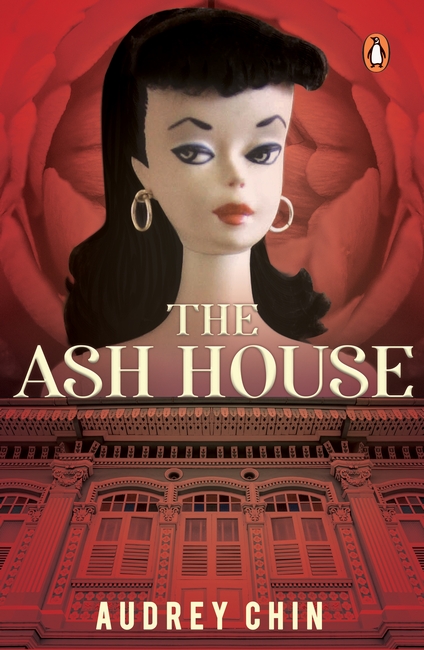
The Tjoa ash house originally intended for ancestral tablets has stood at the top of Kota Cahaya’s exclusive Green Hill for a century. Now, it is all drooping lintels and sagging roof; a haunted house with a haunted heir in it-Arno Tjoa, a Barbie-doll fixated cripple whom Sister Mary Michael, the clairvoyant nun, has been sent to set free.
Arno believes that Bing Fa-the fascinating spirit of a pipa-diva trapped in a ghost marriage to his grandfather-is the key to solving the misfortunes plaguing the house. All will be well with Girl, the comatose maid he is obsessed with, Irene Tjoa his controlling aunt, and the Tjoa fortunes if Bing Fa is released from her doll-house prison.
However, as the family’s skeletons are unearthed, the nun realizes it is not in her power to save everyone or everything. Who must be sacrificed? What must be left to turn to dust?
Set in a 21st century Southeast Asian port city where spirits still linger, The Ash House weaves between the visible and invisible to tell the story of an overseas-Chinese merchant family haunted by the legacy of love gone wrong, with an ending both unexpected and heartbreaking.
The Smart Business Guide to China E-Commerce
‘The Smart Business Guide to China E-Commerce is for any business that is thinking about a China strategy or how to approach international e-commerce. China has perhaps one of the most advanced e-commerce ecosystems in the world, and every retail brand needs a China e-commerce strategy. This book tells you how to make the most of this for your company.’
— Vamsi Mohan Thati, President, Coca-Cola Greater China & Mongolia
China is the largest e-commerce market in the world and the most digital of the major economies. At the same time, many international brands are intimidated by the China market given their lack of familiarity and the significant cultural and language differences.
The Smart Business Guide helps bridge this gap by providing a how-to approach to the China e-commerce ecosystem. E-commerce provides a powerful tool for brands to reach consumers and offers the predictability and statistical feedback that dramatically reduces the costs of a brand to enter the China market.
A quick, punchy read, The Smart Business Guide is a useful book for consumer brands, retailers, and entrepreneurs. It covers critical areas such as:
— How any brand can be a pure-play e-commerce brand in China
— How Chinese consumers are different from U.S. consumers
— The main platforms and social media channels
— Case studies of success and failure in China
— How to deal with market entry challenges, trademark registration, and product approval
— How to compete and win in the most challenging — and most promising — retail market in the world
Land of Sand and Song
Legend has it that a magical spring lies dormant in the heart of the Khuzar desert. Said to be a gift from the gods, the spring holds the cure to all mortal woes. As mercenaries from everywhere try in vain to find the mystical spring, 17-yearold Desert Rose is on the run after her chieftain father is overthrown and captured by rebel clans. Now out for revenge, she sets out alone to the Oasis Capital to assassinate the person instigating the rebellion: the corrupt Emperor Zhao, who will stop at nothing to possess the elixir of life from the spring. To infiltrate the Imperial Guard, Desert Rose must pass a series of trials to test her wit, mettle, and her loyalty. But the real test lies in navigating the cut throat court politics with no ally but a rogue prince and a latent magic stirring in her – magic that can bring a kingdom to its knees or destroy her from within.