



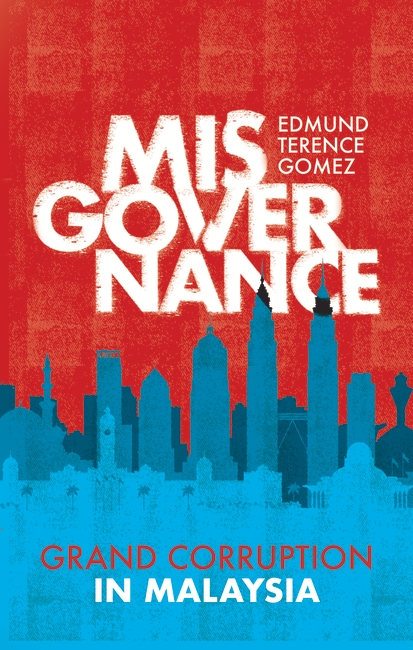
This book unveils covert and deeply disturbing political-economic trends in Malaysia, necessitating an urgent re-think of the meaning of ‘corruption’. On offer is insights into the extensive abuse of power by governing elites who control government-linked companies (GLCs), contributing to grand corruption in numerous forms, including cronyism, collusion, selective patronage, embezzlement, and nepotism. An analysis of a lengthy list of controversial government-business controversies between 1980 and 2023 indicates the presence of a covert and extremely powerful ‘Political-GLC complex’ controlled ultimately by the Cabinet. This long list controversies, along with three case studies, provides insights into the intimate and illicit connections between governing elites and the businesses under their control.
From this book’s insights into the inner workings of Malaysia’s monstrously vast GLC ecosystem, one riddled with graft and political abuse, three major paradoxes emerge. First, what is in place is a deeply corrupted GLC ecosystem that can function legitimately. Second, the persistent rhetoric of government leaders has been of the need to tackle endemic corruption, a palatable statement for a nation deeply distressed about this debilitating problem. However, no politician, whether in government or in opposition, has called for the restructuring of this GLC ecosystem. Third, power is overwhelmingly concentrated in the Cabinet which controls an ecosystem whose misuse can have major economic and political ramifications. Yet, legal avenues to curb misgovernance by ministers are inadequate.
Catagory: Politics
The Siege Within
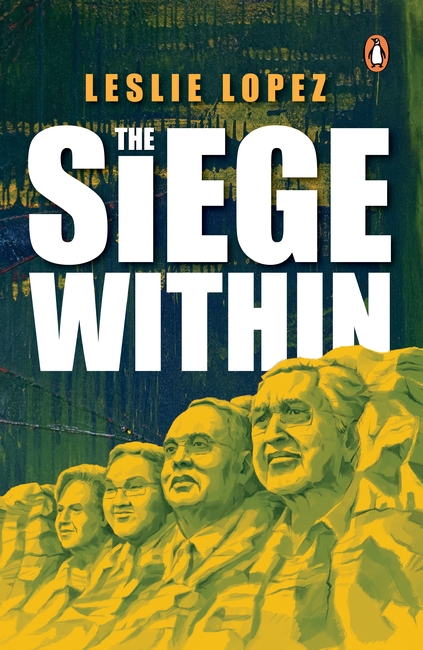
When Malaysia’s sixth prime minister Najib Razak was sentenced to twelve years in prison and fined RM 210 million for stealing billions from the 1MDB state investment fund he had himself set up, it exposed a chain of events that began decades ago, and which continues to reverberate economically, financially and politically, bleeding the treasury and inflicting immeasurable pain on taxpayers for generations to come.
Malaysian journalist Leslie Lopez’s first book, The Siege Within, delves into the writer’s own archives of previously unpublished material to go back in time and show exactly how it was possible for a Malaysian prime minister to envisage his treacherous crime, and then to execute the dastardly deed. From its most ‘innocent’ beginning in a north Malaysian state, Lopez charts how Najib and his warlords set up the investment fund for the sole purpose of stealing from it.
Lopez’s literary debut goes on to show how 1MDB is not just about Najib. The book brings into sharp relief the Machiavellian schemes of a prime minister who sat at the top for more than two decades, and came back from retirement to become PM again in 2022, at the age of ninety-two. The Siege Within paints Mahathir Mohamed as the chief architect of a political system that paved the way for a criminal such as Najib to lie, cheat and steal his way to power, a system which then protected him from scrutiny and prosecution.
One-time central bank governor Zeti Aziz, and the extent of her relationship with the man who delivered billions to Najib on a silver platter, Low Taek Jho, come under a forensic spotlight as Lopez exposes the shocking series of events that culminated in the monstrous enormity of Najib’s deeds. It also depicts how the earth shook for the main players—in Malaysia, Australia, Singapore, the US and Middle Eastern states—once news broke of the biggest case of corruption in world history.
The Siege Within is the untold story behind the political crime that continues to make world headlines, and why a nation so full of promise has been brought to its knees.
Saving the Planet
In December 2022, 40-year-old Nik Nazmi Nik Ahmad was appointed as Malaysia’s Minister of Natural Resources, Environment and Climate Change (NRECC). A career politician, his first ministerial appointment was a baptism of fire as he was thrust into the complex world of environmental policy.
While “green issues” had previously only been an occasional part of his work and activism, executing the Malaysian government’s ambitious sustainability plans brought home to Nik Nazmi how crucial solving climate change is to the country’s survival. He comes to realise that a key component of this task includes winning public support for the required transitions and changes, especially in the face of rising climate change denialism and pessimism.
Saving the Planet relates Nik Nazmi’s experiences as NRECC Minister [later redesignated as the Ministry of Natural Resources and Environmental Sustainability (NRES)] and his thoughts on connected issues ranging from water management to climate financing. He stresses that developing countries—which are especially vulnerable to the destruction that ensues from environmental degradation—back climate action but require viable support from their wealthier counterparts.
Ultimately, climate change must be dealt with not only urgently but also inclusively if humanity is to succeed. It is fundamentally a moral and political challenge that will require radically changing our societies to become more just.
Saving the Planet is a must-read for anyone seeking to understand the intersections between politics and climate change, as well as for an authentic voice at the frontlines of climate action in the Global South.
Shattered Hopes
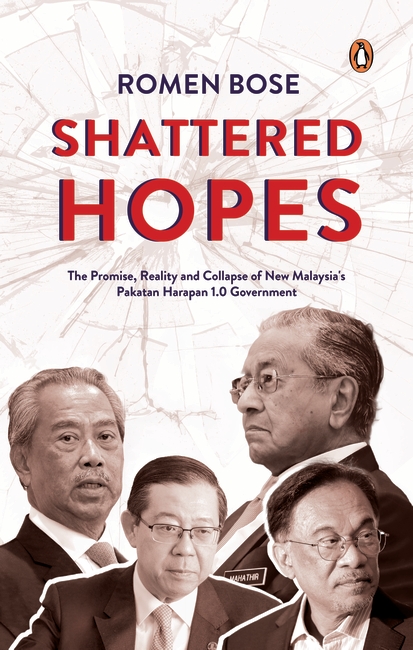
Drawing on interviews with first-hand sources in and outside the administration, official minutes and still classified documents, Shattered Hopes focuses on PH1.0’s rocky 22-months in power to tell the story of how a fledgling Government filled with so much promise and hope, was racked by internal power struggles and politicking even in its very first weeks in power, amid policy paralysis, racial politicking and the ultimate unwillingness of veteran Prime Minister Mahathir Mohamad to hand over power to his twice-anointed successor, Anwar Ibrahim.
In doing so, Shattered Hopes presents readers with a vivid blow by blow account of how broken promises, political patronage and trade-offs, economic dysfunction and racial polarization eventually became the defining characteristics of the promised New Malaysia.
Sri Lanka’s Easter Sunday Massacre
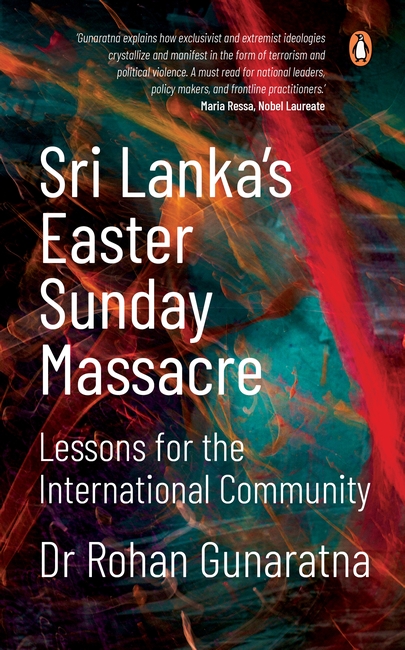
Radical Islam is an enduring global challenge that presents a national and international security threat. Instigation by hate preachers, inadequate government, societal attention, religious and reciprocal radicalization have allowed this threat to manifest into terrorist violence. Extremist ideologies have infiltrated religious, educational, and digital spaces and thus, terrorism’s shadow continues to shroud the safety and stability of countries and communities worldwide today.
On 21 April 2019, the world’s most dangerous threat movement, the Islamic State, mounted one of its deadliest attacks in Sri Lanka. The surge of fear, suspicion, and prejudice following what is now known as ‘Sri Lanka’s Easter Sunday Massacre’ fragmented the country, imbuing hatred and anger against the Muslim community. Years later, the radicalization pipeline remains intact, and the threat persists. With the global expansion of the Islamic State and al-Qaeda, will the world witness attacks of a similar or greater scale in the future?
Equal parts treatise and reference material, Sri Lanka’s Easter Sunday Massacre: Lessons for the International Community answers this question by tracing the genesis, threat trajectory, and aftermath of the bombings and the personalities behind them. With unprecedented access to accounts from Islamic State detainees, affected families, intelligence specialists, and investigators, the book reflects on lessons learned and provides insight into how such attacks are organized and what measures can be taken to prevent or respond to these threats effectively.
ChinaPhobia
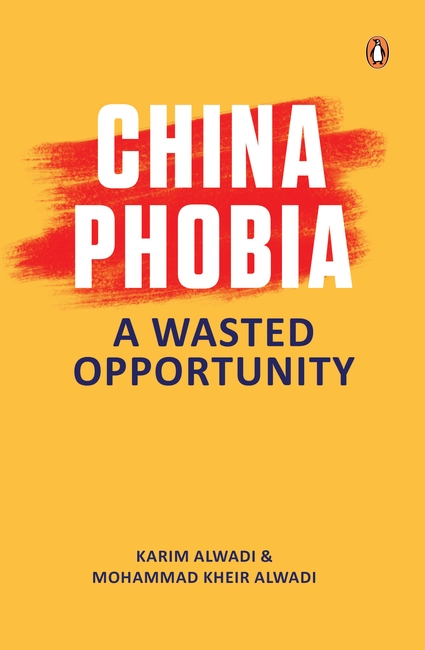
ChinaPhobia – A Wasted Opportunity is an informative book, unbiased towards either China or America. It has been written in the form of a conversation between a father-a former journalist and senior diplomat-and his businessman son. Both academics present the facts combined with insights gained from years of observations of China.
Part one describes the factors that have led to ChinaPhobia: pace of China’s economy, gravitational shifts towards Asia, territorial disputes, lack of soft powers, Belt and Road Initiative, resignation as the ‘world’s factory’, Covid-19, and tries to explain China’s cultural and political thinking.
The second part of the book concerns changes within the economic partnership which led to the increasing distrust of the US government and corporations towards China, reflected not only in their trade war, but also in growing US and Western support for China’s red-lines including Taiwan, Hong Kong, Xinjiang and Tibet. It is mirrored in an ongoing behind-the-scenes arms race, which has a paramount impact on the relationship between the two regimes-and on the rest of the world.
Thirdly, China’s increasingly sensitive ambition towards global leadership is explained, and the roles of various think tanks and experts on both sides is analyzed objectively.
Urgent questions are addressed in the final part of the book. Without a timely response, inflating ChinaPhobia could become the biggest threat to global peace, economic growth and stability, poisoning international relations in the coming years. The authors discuss the means of mitigation at home and abroad.