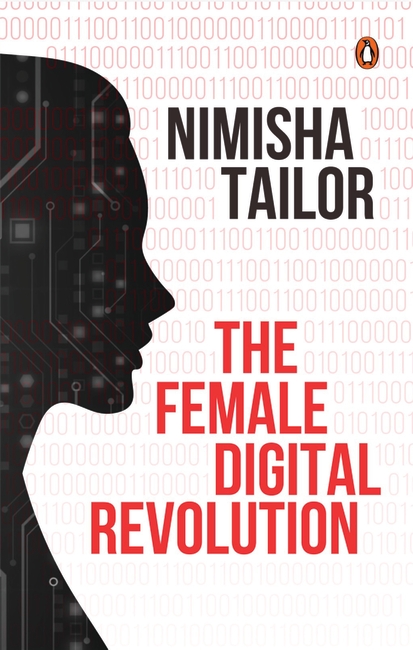
Smartphones, digital payments and health apps are examples of how technology is empowering women to upskill, lead or start tech companies and live healthier and greener lives. The digital revolution is dramatically transforming the role of women in the economy delivering new opportunities to work, play and learn. But women are missing out. Not enough innovative technologies are being developed ‘by women’ or ‘for women’ leading to untapped benefits for the female population and missed opportunities for businesses and government to cater to half of the world’s population.
The Female Digital Revolution provides a unique insight into the changing role of women in the digital economy which is growing at an unprecedented rate. Through a collection of powerful real-life stories and research, it brings to life current and future digital changes that are reshaping the role of women. It urges government and businesses to start consciously thinking about women as powerful digital economic agents, highlights the need to increase female participation in all aspects of our digital economy, and implores all relevant actors—investors, entrepreneurs, CEOs, public leaders, and the like—to be part of the female digital revolution.

Society is uncomfortable with two factors: women in power, and women with money. But, why is that so? Despite the societal advancements the world has made since universal suffrage, women are still uncomfortable discussing money matters with their partners and peers.
In this book, 24 powerful women bare their souls to finance professionals Sharon Sim and Serena Wong about their struggles with making money and keeping it, their sometimes uncomfortable relationship with the all-powerful dollar, and how they’ve come to terms with, even celebrate, their financial and personal status in the world.

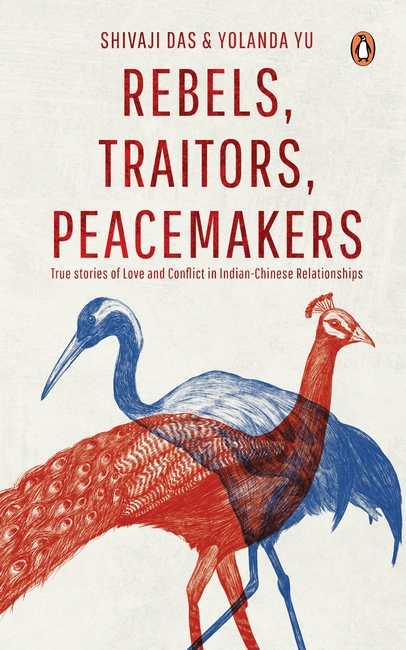
‘You shouldn’t be with a Chinese girl…that should be my girl,’ a man in Singapore allegedly said this to a Chinese-Indian couple as he spat towards them. In a world brimming with such prejudice and cultural tensions, a remarkable phenomenon emerges: nearly one in five marriages in the USA and Singapore are now interracial. “Rebels, Traitors, Peacemakers,” explores this phenomenon through real stories of Indian-Chinese relationships, delving into the love and turmoil in such lives, where cultural boundaries are shattered and hearts are forged against all odds.
Spanning across Asia, Europe, and the Americas, these heartfelt accounts transcend borders, age, and sexual orientation to illuminate the unfiltered reality of cross-cultural unions. Families disown their own flesh and blood, individuals get locked and beaten up, and online trolls attack relentlessly. Married life offers no respite – cultural expectations breed misunderstandings, life seems hopeless in front of the unfamiliar letters on the washing machine, and differing parenting styles fuel frequent arguments over raising kids. The couples often ask themselves – why did I make my life so complicated?
And yet, the featured stories reveal the couple’s deep admiration for each other and a steely commitment to sustain their syncretic relationship. The Chinese father-in-law now dances Indian style. Strict vegetarians start cooking meat. While their love first appeared as treacherous rebellion, its endurance transforms lives and communities, forging a path towards unity in our fragmented world.
Journey alongside these bold protagonists, who through their triumphs and struggles, illuminate the intricacies of human nature and our universal yearning for connection.
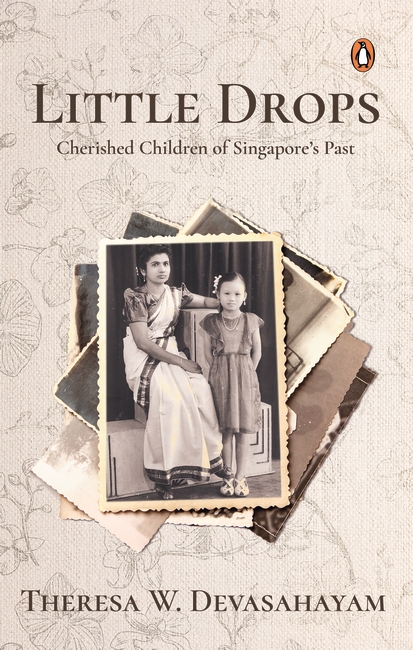
Little Drops: Cherished Children of Singapore’s Past is a compilation of biographies based on historical fact about the pain of separation and the lure of love, and how these themes constantly collide. These never-before-told stories chronicle how fourteen adoptees from the 1930s to the early 1970s in Singapore found a forever home when their own biological parents could not raise them. These stories recount the plight of families of that era; the strength of friendships and informal social networks; Singapore’s migrant heritage; how lives were thrown into turmoil during the Japanese Occupation; and the struggles individuals had borne during that period leading up to Singapore’s independence. Unfolding in these stories are the recurrent subthemes of poverty, superstition, how girl children were valued amongst the Chinese, how a family illness or death was culturally construed, and the magnanimous spirit of families taking in these abandoned children. What is most striking about many of these children is that they were sometimes not legally given away, seeming odd since children could be passed around so easily. And yet these children would almost always end up in safe, loving and caring homes of another culture. Grappling with who they are in terms of their ethnic identity is very much a common experience amongst all these adoptees. But rather than struggling between two cultural worlds, these adoptees almost always have a firm sense of longing and belonging to their families of adoption instead of their families of origin.

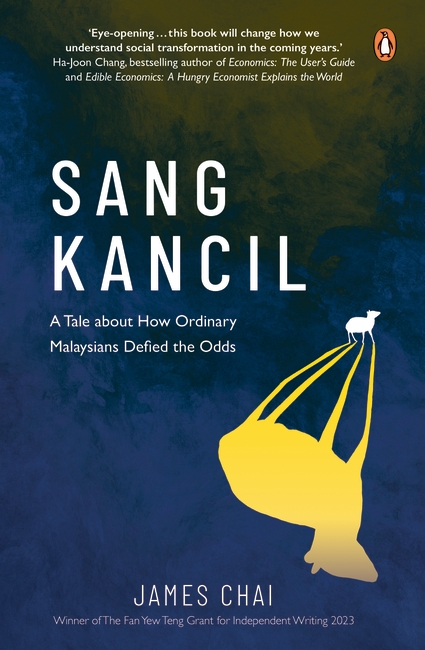
Ordinary is not as ordinary as you think. History is written by the loudest and most charismatic victors, but are silent about the true movers and shakers: the rebels, the honest servants, the quiet doers, the square pegs in a round hole, and the ordinary believers who kept showing up.
Through seven moving tales of courage, prolific Malaysian writer, James Chai, shows us in his debut book how:
– A frail 70-year-old woman became the face of Malaysia’s largest protest that helped overturn the longest-ruling regime in the world;
– A mother-of-two fought through gender and racial unfairness and became the first Asian woman to win the ‘Nobel Prize for Cancer Research’;
– A middle-aged, middle-level government servant exposed the largest white-collar crime in the world;
– A punk graphic artist persevered through multiple arrests and drew one of the most recognisable activist artworks in the region;
– An indigenous retiree battled powerful governments and corporations to usher in one of the largest environmental victories in Southeast Asia;
– A group of leaderless Sikh organisation saved the lives of thousands in the worst flood in modern Malaysian history; and
– A suburban bottom-of-class student found his way through modern history’s bloodiest wars and won the Pulitzer Prize.
Sang Kancil will force us to reassess what is truly important and remind us of what we are capable of. Filled with research-backed theories, this book is a call-to-action for the underdogs battling our own giants.

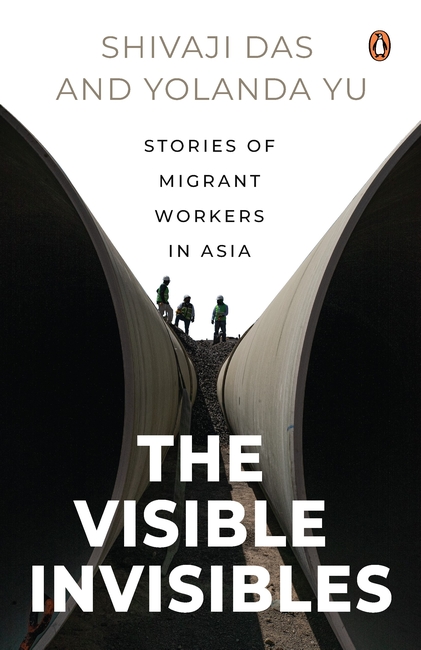
A domestic worker from the Philippines runs away from her husband who’s set out to kill her. A mine-blaster looks at his X-ray scan to realize that all he has earned from his sixteen years of work is a catalogue of chronic diseases. An undocumented factory worker in Malaysia takes refuge in the wild to escape from the police.
A construction worker in India is abducted and sold as a bride to a stranger. Migrant sex workers in Thailand scrimp to stretch their vanishing savings, having lost all their customers due to COVID-19. A cleaner from China struggles to cope with the cultural oddities while working in an Indian restaurant. Domestic workers in Singapore lament the hopelessness of finding love in a foreign land. A landscaper tries to rebuild his life with a reconstructed ‘alien’ face after he suffers a massive explosion. A project engineer who once hated his native village, now plants trees to preserve its nature.
Told in their own voices, the stories presented in this collection paint an intimate portrait of the lives of low-wage migrant workers in Asia. By exploring themes of employer-employee power imbalance, love, death, religion, racism, friendship, alienation, family dynamics, digital inequality, social liberties, and migration’s transformative capacity, the collected stories provide a nuanced understanding of domestic and international migration, one of the defining trends in our world today.
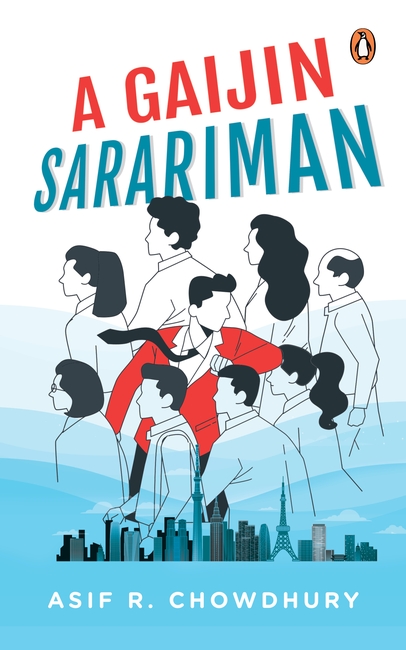
People who work for companies for monthly salaries are known as sarariman in Japan. They are the foot soldiers who, through their hard work and dedication, enabled the meteoric transformation of Japan into a global economic powerhouse from the ruins of the Second World War. Like the famous bushido or the ‘way of the warrior’ of the old samurai clan, these sarariman are a breed of their own, with their own work ethics and social practices. The author has spent over twenty years working closely with these sarariman from various Japanese companies and lived and worked in Tokyo for four years. A Gaijin Sarariman is a first-hand account of the author’s journey, working in Japan as a gaijin (foreign) sarariman, infused with two decades of experience dealing with the local people from all walks of life providing meaningful insights into the unique Japanese culture.
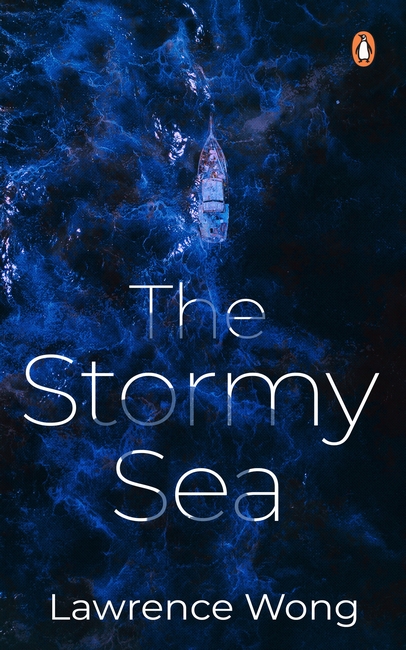
The Stormy Sea is a true story about ordinary men coming together to protect the vulnerable fleeing Vietnam on the Southern Cross ship. The band of brothers dealt with everything from pirates, birth, fire and flooding on board to organising their own rescue from the Indonesian island where the Southern Cross eventually ran aground.
To this day, the author still remembers in detail the calm water and the smell of diesel on the fishing trawler he was cramped in all night with his family.
Lawrence was appointed leader on the ship backed by the European Captain and his crew to lead the 1,200 refugees on the deck of the Southern Cross. This was prompted by a gang of young men confiscating food and extorting money for instant noodles. Lawrence realised his five young children wouldn’t stand a chance of surviving had he not taken charge.

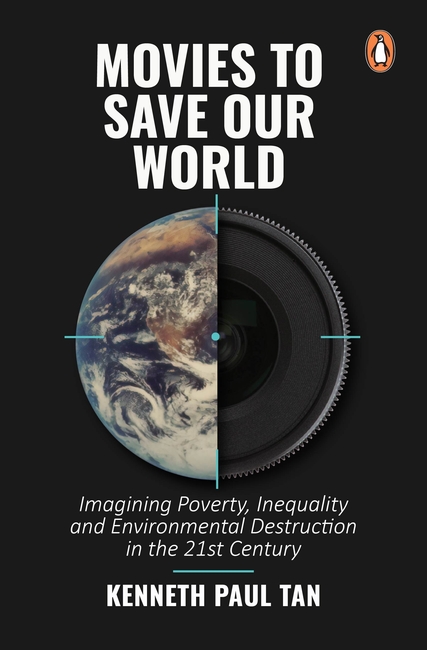
Through a close analysis of more than seventy popular documentaries and feature movies from around the world, produced in the twenty-first century, this book explores the theme of poverty, inequality, ecological degradation and revolutionary change, all associated with a contemporary crisis of neoliberal globalization in a world where it has become so pervasive. Profit rules, while poverty and inequality make the political ground fertile for populist manipulation. By returning power to the people, healthier forms of populism can lead the way to progressive revolutionary change that enriches democracy and corrects for social injustice. However, through ideological and political manipulation, populism can also take more debased authoritarian forms, promoting conformism, domination, exploitation, marginalization and degradation of humanity and its habitat.
The book urges progressive moviemakers to take advantage of advancements in digital technologies and to collaborate, in post-pandemic times, with educators to develop public deliberation skills and inspire a new generation of informed and compassionate change-makers.

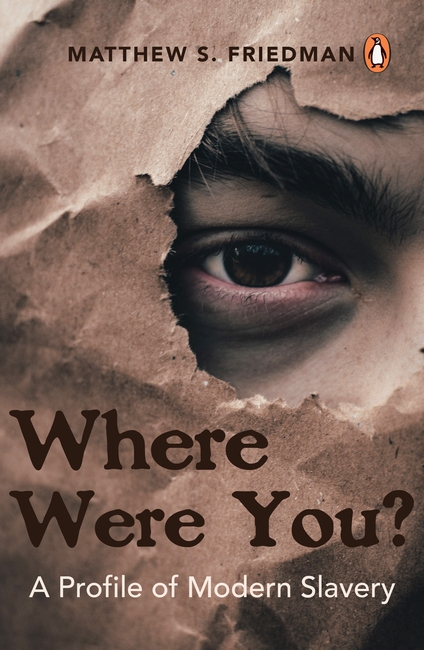
There are more slaves in the world today than any other time in history.
Enter the world of human trafficking and explore what we can do together to end this global crime. Where Were You?: A Profile of Modern Slavery by Matthew Friedman provides an up-to-date overview of human trafficking, a largely ignored present-day evil, and recounts true stories of enslavement in Asia today. Former United Nations and USAID expert Matthew Friedman obtained in-depth first-hand knowledge with boots-on-the-ground work over 30 years throughout Asia. Human trafficking exists in nearly every nation on earth and Friedman has personally interviewed hundreds of freed slaves and imprisoned traffickers throughout South and Southeast Asia.
The modern slave trade operates in brothels, fisheries, clothing and chocolate industries, as well as a myriad of other manufacturing jobs and is a billion dollar business that continues to grow unchecked.
Even with the collective response of governments, the UN and civil society partners, less than 0.2 percent of the victims are assisted.
“We’re not winning the fight against human slavery. Relying solely on the anti-slavery community around the world to tackle the scourge of modern slavery and the criminals behind it simply is not working. Unless something drastic changes, this trend will continue unabated,” writes Friedman.
This book not only reveals the plight of human trafficking victims, Friedman also offers valuable advice and guidance related to his own personal experiences working in the counter-trafficking and development world. He offers valuable lessons for those thinking about entering this field.